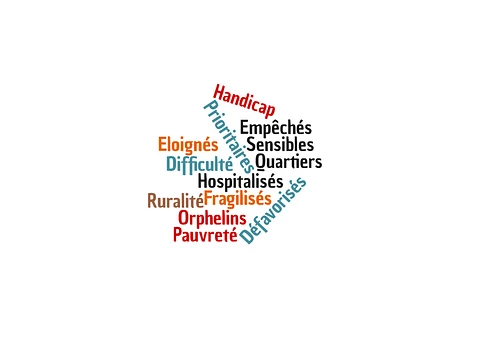
Young people who are "vulnerable," "disadvantaged," "in difficulty," "disabled," "culturally isolated," "orphaned," "from sensitive or priority areas"... These terms appear very regularly in the press, in calls for projects from foundations and institutions, and in the discourse of many non-profit organizations.
But what are we really talking about when we refer to undifferentiated access to culture?
At Konstelacio, we often strongly disagree with what many people mean by this expression. In theory, there is nothing more noble than bringing these culturally isolated audiences what they often lack access to: shows, exhibitions, artistic creation projects, trips, exchanges... It is therefore understandable that patrons wish to support initiatives that promote this, and that the press highlights this desire to help those who need it most. Unfortunately, in many cases, projects are created solely for these vulnerable audiences and there is often little interaction with non-disadvantaged audiences, which has the effect of stigmatizing the former, even though this is never the intended objective.
"Solidarity, xxx [name], helping orphans"
"A Cambodian's commitment to orphans is moving..."
"Children, women, and disadvantaged young people are the focus of xxx [company]'s philanthropic efforts."
"Solidarity. Disadvantaged children have their lucky star."
These headlines and excerpts from press articles, usually accompanied by photos of children, highlight the work of organizations that do good things and fight every day to help these disadvantaged groups. There are also numerous articles on corporate foundation websites showcasing their commitment. However, this communication serves as a reminder that the actions in question are intended for these groups.
At Konstelacio, undifferentiated access to culture is one of our fundamental principles. We are convinced ofthe importance of culture and education in the development of every child and young person, regardless of their background and constraints. In our view, this also means that it is essentialnot to stigmatize them more than they already are. That is why we insist on the importance of keeping in mind the original meaning of the word "undifferentiated."While primarily targeting vulnerable audiences, the association refuses to reserve access solely for them, so as not to reduce them to their status as disadvantaged children or young people, orphans, or people with disabilities. Our projects are therefore carried out in public and private schools, children's hospitals, and orphanages.Children and young people interact and participate in our projects on an equal footing, from India to Mexico to Cambodia, from affluent neighborhoods to townships to rural areas.
We hope that, over time, more and more stakeholders in education, culture, and solidarity willtake this key issue into account.